On this page
- Is This Program for You?
- Eligibility Criteria
- Step-by-Step Application
- Supporting Documents Checklist
- Timeline and Processing
- Where Applicants Go Wrong
- How It Compares to Alternatives
- Fees and Financial Requirements
- What You Can and Cannot Do
- Real-World Examples
- Visa options for this goal
- Guides for India
- Other goals for India
Is This Program for You?
#The Overseas Citizen of India (OCI) card is a long-term visa for individuals of Indian origin, offering them the opportunity to live, work, and study in India without being full citizens. This program is particularly suitable for those who have a historical connection to India and wish to maintain strong ties with the country.
Who Is Eligible for the OCI Card?
The OCI card is designed for foreign nationals who have a direct lineage to India. Here are the specific eligibility categories:
- Former Citizens: Individuals who were citizens of India at any time after January 26, 1950, or were eligible to become citizens at that time.
- Territorial Changes: Those from territories that became part of India after August 15, 1947.
- Descendants: Children, grandchildren, or great-grandchildren of Indian citizens.
- Minors: A minor child of a person eligible for OCI.
- Spouses: Spouses of Indian citizens or OCI cardholders, provided the marriage has subsisted for at least two years.
Why Consider the OCI Card?
The OCI card is an excellent choice for individuals who wish to enjoy several benefits akin to those of Indian citizens, without renouncing their current nationality. Key advantages include:
- Lifelong Visa: The OCI card grants a multiple-entry, multi-purpose lifelong visa to visit India.
- Economic Benefits: Cardholders can engage in business and own property in India, similar to Indian citizens.
- Educational and Employment Opportunities: They can study and work in India without additional permissions.
- Simplified Travel: With the OCI card, you can avoid the hassle of applying for a visa each time you visit India.
Key Considerations
While the OCI card offers numerous benefits, it is important to remember certain conditions and limitations:
- Special Permissions: Activities such as research or missionary work require special permission despite holding an OCI card.
- Renewals and Updates: Although the Government of India has relaxed requirements for re-issuance of the OCI card when new passports are issued, updates are still necessary at certain ages.
Important: Always verify the latest requirements and guidelines on the Bureau of Immigration website to ensure compliance with current regulations.
For more detailed guidance and application steps, you can refer to the How To Apply and Documents Checklist available in our resources.
Eligibility Criteria
#To apply for an Overseas Citizen of India (OCI) card, which offers several benefits similar to those of full citizens, you must meet specific eligibility criteria. Understanding these requirements can help you determine if you qualify to lodge an application with the Foreigners Regional Registration Office (FRRO) in India.
General Eligibility
- Former Indian Citizens: You must be a citizen of another country but were a citizen of India at any time after the commencement of the Indian Constitution on January 26, 1950.
- Eligible at Indian Constitution Commencement: You were eligible to become a citizen of India on January 26, 1950, and are now a citizen of another country.
- Territorial Changes: You belonged to a territory that became part of India after August 15, 1947, and are currently a citizen of another country.
Family-Based Eligibility
- Descendants of Indian Citizens: You are a child, grandchild, or great-grandchild of someone who is or was a citizen of India.
- Minor Children: You are a minor child of a person who falls under the above categories.
- Spouses: You are a spouse of foreign origin of an Indian citizen or an Overseas Citizen of India Cardholder. Your marriage must have been registered and subsisted for a continuous period of at least two years immediately preceding the application.
Age and Passport Requirements
- While there is no specific age requirement for applying for an OCI card, note that if you are below 20 years of age, or above 50 years of age, special provisions apply regarding passport renewal:
- Under 20 Years: No requirement to update the OCI card with each new passport until you turn 20.
- Above 50 Years: You only need to update your OCI card once with a new passport issued after reaching 50.
Tip: Ensure that you have all necessary documentation, such as proof of Indian origin or a marriage certificate, to substantiate your eligibility. For a complete list of required documents, refer to the Documents Checklist.
Important Considerations
- Proof of Indian Origin: Documents like birth certificates or previous Indian citizenship documentation are necessary to support your application.
- Marriage Documentation: For spouses, a valid marriage certificate is essential.
- Updates Upon Passport Renewal: If applicable, remember to upload a copy of your new passport and latest photo as required. This is especially crucial for applicants under 20 and over 50 as mentioned above.
For more detailed information on the application process, visit How To Apply and ensure you have reviewed all aspects of your eligibility. If you're considering other visa options, explore the Entry Visa as an alternative.
Step-by-Step Application
#To apply for the Overseas Citizen of India (OCI) Card, follow these steps to ensure a complete and accurate application. This card allows eligible individuals to enjoy various privileges in India without acquiring full citizenship.
Step-by-Step Application Process
-
Verify Eligibility
Begin by confirming your eligibility for the OCI card. You must be a foreign national of Indian origin or related categories specified under Indian law. This includes former Indian citizens, descendants of Indian citizens, and spouses of Indian citizens or OCI cardholders. Make sure to review the specific criteria related to your background.
-
Online Application
Access the official OCI services portal to start your application. Create an account if you haven't already, and fill out the online application form accurately. Ensure all personal details match your supporting documents. Double-check for completeness and accuracy to avoid common pitfalls.
-
Gather Required Documents
Prepare the necessary documents to support your application, including:
- Proof of Indian origin or connection, such as birth certificates or prior Indian citizenship documents.
- A marriage certificate, if applying based on marriage to an Indian citizen or OCI cardholder.
- Copies of your current passport and a recent photograph.
Consult the Documents Checklist for a comprehensive list of required documents.
-
Upload Documents
Upload digital copies of your documents on the OCI services portal. Make sure the files are clear and appropriately labeled, as missing or unclear documents can delay your application. You must update your passport and photo documentation each time a new passport is issued for applicants up to 20 years of age and once after turning 50.
Tip: Keep digital backups of all uploaded documents for your records.
-
Pay the Application Fee
The application process involves a fee, which varies depending on your location. Pay the fee through the portal using the available payment methods. Note that fees are subject to change, so verify the current amount on the official website.
-
Submit Original Documents for Verification
After completing the online application, submit your original documents for verification at a designated Indian mission or FRRO office. This step is critical to confirm the authenticity of your documents.
-
Track Your Application
Use the provided application reference number to track the status of your application online. Processing times can vary, so regularly check for updates and be prepared to provide additional information if requested.
By following these steps and ensuring accurate documentation, you can navigate the OCI card application process efficiently. For further assistance, consult the How To Apply guide.
Supporting Documents Checklist
#When applying for an OCI Card for India through the Foreigners Regional Registration Office (FRRO), it's important to gather all necessary documentation to support your application. Below is a checklist of the supporting documents you may need to provide, organized into relevant categories.
Proof of Indian Origin
- Documentation showing Indian citizenship: This can include a previous Indian passport, a copy of the Indian citizenship certificate, or any official government-issued document that demonstrates your connection to India.
- Birth certificate: If you were born in India or your parents or grandparents were Indian citizens, you'll need to provide birth certificates as proof.
- Passport or citizenship details of ancestors: Documents that establish the citizenship of your parents, grandparents, or great-grandparents can be crucial.
Personal Identification
- Current passport: A valid passport from your current country of citizenship is required. Ensure it has enough validity for the duration of your OCI status.
- Photographs: Recent passport-sized photos as per the specifications outlined by the Bureau of Immigration.
- New passport and latest photo submission: For applicants under 20 years of age or those over 50, upload a copy of your new passport and a recent photo each time a new passport is issued.
Marital Status
- Marriage certificate: If applying as a spouse of an Indian citizen or an OCI cardholder, provide a marriage certificate. Ensure the marriage has been registered and has subsisted for a continuous period of not less than two years immediately before the application.
Minors
- Parental documents: For minor children applying through their parents' Indian origin, include copies of the parents' passports, OCI cards, or proof of Indian citizenship.
- Parental consent letter: If only one parent is applying on behalf of a minor, a notarized consent letter from the other parent may be required.
Translations and Certifications
- Certified translations: If any of your documents are in a language other than English or Hindi, provide certified translations to avoid delays.
- Apostille or notarization: Some documents may require apostille certification or notarization to be accepted by Indian authorities.
Important: Ensure all documents are up-to-date and verify requirements specific to your eligibility category on the OCI Application page before submission. Failure to provide necessary documentation can lead to delays or rejection of your application.
For more details on visa processes and document submission, you might find the Visa Refusal Reasons and Visa Extension Guide helpful. Remember to keep a copy of all documents for your records and refer to the Documents Checklist for comprehensive guidance.
Timeline and Processing
#The processing time for obtaining an OCI card in India can vary depending on several factors, but typically, it ranges from 8 to 10 weeks from the date of application submission. This timeline includes the verification of documents and the issuance of the card. It's important to note that the processing time can fluctuate based on the volume of applications received by the Foreigners Regional Registration Office (FRRO) and other related agencies.
Factors Affecting Processing Time
Several factors can influence how quickly your OCI application is processed:
- Volume of Applications: Higher demand periods, such as around major Indian festivals or summer holidays, may increase processing times.
- Completeness of Application: Ensure all required documents are submitted and correctly filled to avoid delays.
- Verification Requirements: Additional verification of documents may be required, especially for applicants with complex cases or those who do not provide clear proof of Indian origin.
Expedited Processing Options
Currently, there are no official expedited processing options for OCI applications. However, you can take steps to potentially speed up the process:
- Submit Complete Documentation: Double-check that all required documents are included and meet the guidelines provided in the Documents Checklist.
- Track Your Application: Use the online tracking system regularly to monitor your application's status and respond promptly to any requests for additional information.
Tip: Submitting a well-prepared application initially can significantly reduce the likelihood of delays.
What to Expect After Submission
After you have lodged your application, you should receive an acknowledgment receipt with a reference number. This number allows you to track your application status online. Once your OCI card is ready, you will be notified to collect it from the designated office.
For those interested in exploring visa options in India, such as the E Tourist or Entry visas, make sure to review the specific requirements and processing times for each type. Additionally, understanding the Visa Refusal Reasons can help in preparing a successful application, whether for an OCI card or other visa types.
Where Applicants Go Wrong
#Numerous applicants encounter challenges that can lead to delays or even refusal. Being aware of potential pitfalls can significantly improve your chances of a successful application.
Common Documentation Errors
-
Lack of Proof of Indian Origin: One prevalent issue is failing to provide adequate proof of Indian origin or connection. Ensure you gather all necessary documentation, such as birth certificates, previous Indian citizenship documents, or other relevant records that establish your eligibility.
-
Incomplete or Incorrect Submissions: Submitting incomplete or incorrect information is a frequent reason for application refusal. Double-check that all sections of your application are thoroughly completed and that all supporting documents are correctly attached.
-
Passport and Photo Updates: For applicants under 20 or over 50, it is essential to upload a copy of your new passport and a recent photo after receiving a new passport. Missing this requirement can result in processing delays.
Application Timing and Visa Type
-
Incorrect Visa Status: Applying for an OCI card while on a Tourist Visa, Missionary Visa, or Mountaineering Visa is not permitted. Ensure your current visa status aligns with the application requirements. For more information, consider exploring different visa types such as E Tourist or Business Visa if needed.
-
Special Permissions: Activities like research or missionary work often require special permission. Not obtaining this permission can lead to application issues or legal consequences. Consult the Research Visa guidelines if your activities require it.
Misunderstanding Eligibility
-
Spouse Eligibility: For spouses of Indian citizens or OCI cardholders, it's crucial to provide a marriage certificate and demonstrate that the marriage has been registered and subsisted for at least two years. Misunderstanding these requirements can lead to unnecessary complications.
-
Generational Eligibility Confusion: Misinterpretations about eligibility for children, grandchildren, or great-grandchildren of Indian citizens can occur. Verify your eligibility through available How To Apply resources to avoid this common pitfall.
Important: Always review the specific instructions for your eligibility category before starting your application process to avoid common errors.
How It Compares to Alternatives
#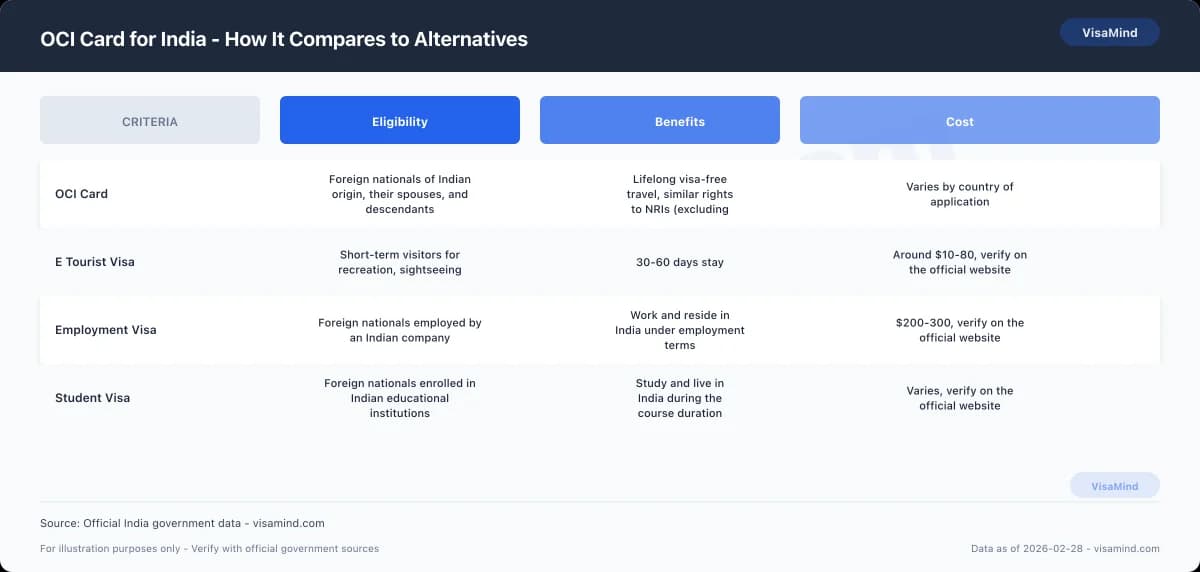
The Overseas Citizen of India (OCI) card offers several advantages and is often compared to other visa options available for foreign nationals with Indian connections. Understanding how the OCI card stands out in comparison to other visas or programs in India can help you make an informed decision.
How OCI Compares to Other Indian Visa Options
Here's a detailed comparison of the OCI card with other similar visas available in India:
| Visa Type | Eligibility | Rights & Privileges | Cost | Timeline |
|---|---|---|---|---|
| OCI Card | Foreign nationals of Indian origin, spouses of Indian citizens or OCI cardholders | Long-term stay without visa restrictions, multiple entry, parity with NRIs in financial and economic fields | Varies, typically less frequent renewals | Permanent, with periodic passport updates required |
| E Tourist Visa | Short-term tourists | Limited to tourism activities, no business or employment | Low, varies by country | Valid for 60 days, extendable |
| Employment Visa | Foreign nationals employed by an Indian company | Work and reside in India during employment | Higher, includes processing fees | Valid for the duration of employment, typically up to 5 years |
| Student Visa | Full-time students in recognized institutions | Study and reside in India for the duration of the course | Varies, includes tuition-related costs | Valid for the duration of the course, extendable |
Key Differences
-
Eligibility: The OCI card is specifically targeted at individuals of Indian origin and their families, offering them a quasi-citizenship status without full citizenship rights. In contrast, other visas like the E Tourist Visa or Student Visa are meant for specific purposes like tourism or education.
-
Rights & Privileges: OCI cardholders enjoy significant benefits, including the ability to live and work in India indefinitely, without the need for frequent visa renewals. They also have economic rights similar to Non-Resident Indians (NRIs), which are not available to holders of other visas.
-
Cost and Timeline: The OCI card involves an upfront cost for application, but it does not require frequent renewals like other visas. While Employment Visas and Student Visas may have higher initial costs, they are usually tied to the duration of employment or study and require extensions.
Tip: Consider an OCI card if you have Indian heritage and plan to spend extended periods in India, as it offers more flexibility and fewer restrictions compared to other visas.
By understanding the distinctions among these options, you can better assess which visa or program aligns with your long-term plans in India. For more detailed guidance, refer to our comprehensive Visa Extension Guide or explore specific scenarios like Work and Study.
Fees and Financial Requirements
#When applying for an Overseas Citizen of India (OCI) card, understanding the associated fees and financial requirements is critical. Here, we'll break down the costs involved and what financial evidence you may need to present.
Application Fees
The application process for an OCI card involves certain fees, which can vary based on the specifics of your situation. The following table provides an overview of the fees commonly associated with the OCI card application:
| Item | Details | Cost (INR) | Notes |
|---|---|---|---|
| Application Fee | Basic fee for processing | 15,000 | Non-refundable fee for new OCI applications. |
| Re-issuance Fee | For new passport or changes | 5,000 | Applicable when re-issuing OCI due to new passport or personal details. |
| Postal Charges | If applicable | Varies | Depending on your location and preferred delivery method. |
Important: These fees are subject to change. Verify the latest fees on the official website before proceeding with your application.
Financial Proof Requirements
While there are no explicit salary thresholds or investment minimums for OCI applications, you must provide proof of your Indian origin or connection. This includes:
- Proof of Indian Citizenship: Previous Indian citizenship documents, if applicable.
- Birth Certificates: For those who are descendants of Indian citizens.
- Marriage Certificate: Required for spouses of Indian citizens or OCI cardholders.
- New Passport: A copy of your new passport and a latest photo is mandatory if under 20 or over 50 years of age.
Common Financial Considerations
Although direct financial thresholds are not specified, it's wise to maintain a clear record of your financial status. This can be beneficial if you are required to demonstrate your ties and stability, especially if you are applying as a spouse or descendant.
Tip: Retain copies of all financial documents submitted. This will aid in any future reference or re-issuance processes.
For more details on the application process, you can refer to the OCI Application form. Additionally, consider exploring the Financial Requirements guide for a deeper understanding of what's expected during the application process.
What You Can and Cannot Do
#The Overseas Citizen of India (OCI) Card provides several benefits to individuals of Indian origin residing abroad. However, it is important to understand both the privileges it confers and the limitations it imposes.
What You Can Do
With an OCI Card, you enjoy many rights similar to an Indian citizen, particularly in terms of travel and residence:
- Multiple Entry and Lifelong Visa: You can enter India multiple times without the need for a separate visa. The OCI card serves as a lifelong visa, eliminating the hassle of visa renewals.
- Work Rights: You can work in most sectors in India. However, certain occupations may require additional permissions or qualifications.
- Property Ownership: You have the right to purchase residential and commercial properties in India, though agricultural land is excluded.
Tip: Always carry your OCI card and passport when traveling to India, as both documents are required for entry.
What You Cannot Do
Despite its advantages, the OCI Card does not grant full citizenship rights:
- Political Rights: You cannot vote in Indian elections or hold public office.
- Restricted Activities: Some activities, such as missionary work or research, may require special permissions. It's advisable to consult the Research Visa guidelines for more information.
- Agricultural Land: You are not permitted to own agricultural land or plantation properties.
Family Members and Dependents
An OCI Card can extend benefits to family members under certain conditions:
- Spouses: Spouses of Indian citizens or OCI cardholders are eligible if the marriage has been registered and has subsisted for at least two years.
- Children: Minor children of eligible parents can also acquire OCI status.
For specific requirements related to family applications, refer to our Documents Checklist.
Important: Any change in personal details, such as marital status or address, should be promptly updated with the FRRO to avoid complications.
Understanding these rights and limitations will help you make the most of your OCI Card while ensuring compliance with Indian regulations. For more details on how the OCI Card compares to other visa options, explore our Visa Extension Guide.
Real-World Examples
#A retired engineer residing in the United States, originally from India, wanted to reconnect with his cultural roots by spending extended periods in India. He decided to apply for an Overseas Citizen of India (OCI) Card, which would allow him to enjoy the benefits of living in India without the need for regular visa renewals. To apply, he utilized the official OCI services website to complete his application. He then submitted his original supporting documents, including proof of his previous Indian citizenship, at the designated FRRO office for verification. Following the prescribed process and ensuring all documents were in order, he received his OCI card within a few months, allowing him to immerse himself in India's vibrant culture at his leisure.
Scenario: A Young Professional Marrying an Indian Citizen
A young professional from Canada recently married an Indian citizen and wished to establish a life in India. Understanding that her marriage had been registered and had subsisted for more than two years, she was eligible to apply for an OCI card. She accessed the Bureau of Immigration portal to gather the necessary information and began her application by uploading her marriage certificate and other required documents. After lodging the application and attending a verification appointment at the FRRO, she successfully acquired her OCI card within three months. This status granted her the ability to live and work in India alongside her spouse, enhancing her connection to her new home.
Scenario: An Academic Planning Long-term Research in India
An academic from the UK was planning to conduct long-term research in India, which required frequent travel and extended stays. To facilitate her movement, she opted for the OCI card, which would allow her to work without needing a separate Research Visa. She started by reviewing the eligibility criteria on the OCI services website and gathered the necessary documents, including proof of her Indian lineage. Her application was lodged online, and after a thorough check by the FRRO, she received her OCI card. This card provided her the flexibility she needed to engage in her research activities over the next few years, without the constraints of traditional visa limitations.
FAQs
What is the fee for applying for an OCI Card for India?
Is there a requirement to update my OCI Card for India upon passport renewal?
What supporting documents are needed for an OCI Card for India application?
How does the OCI Card for India compare to other visa options?
Can I switch from an OCI Card for India to full Indian citizenship?
What common mistakes should be avoided when applying for an OCI Card for India?
Can I hold an OCI Card for India and apply for a work visa simultaneously?
Sources
Last reviewed: March 1, 2026
VisaMind provides informational guidance only and is not a government agency. This is not legal advice. Requirements can change and eligibility depends on your specific facts. If your case is complex or high-stakes, consult a licensed immigration attorney.
Next steps
Requirements vary by nationality, purpose, timeline, and case details. Use Find My Visa to get a personalized checklist for India with official sources and deadlines.
Find my visa