Entry Requirements at a Glance
#India's entry requirements are diverse, catering to a wide range of international visitors. Here's what you need to know to begin your journey to India.
Visa-Free and Visa on Arrival Options
India offers a Visa on Arrival service exclusively to nationals of Japan, South Korea, and the United Arab Emirates (UAE) under specific conditions. Japanese and South Korean nationals can avail themselves of this facility without prior e-Visa or regular visa. For UAE nationals, a prior e-Visa or regular visa is required to qualify for Visa on Arrival.
Exploring the e-Visa
For most travelers, the e-Visa is the most convenient option, streamlining the process of obtaining permission to enter India. The e-Visa is available for nationals of over 160 countries, making it accessible to a vast number of international visitors. It supports various purposes such as tourism, business, medical treatment, and attending conferences.
- Validity: The e-Visa allows a stay of up to 60 days in India.
- Types: There are several categories, including e-Tourist Visa, e-Business Visa, and e-Medical Visa.
- Eligibility: Ensure your passport has at least six months of validity and two blank pages. Nationals of countries listed on the e-Visa portal can apply.
Important: If your stay exceeds 180 days, you must register with the Foreigners Regional Registration Office (FRRO).
When is a Regular Visa Required?
A regular visa is necessary if you are ineligible for an e-Visa or require a stay longer than the e-Visa permits. This applies to individuals engaging in employment, journalism, or NGO activities. Regular visas are typically processed through Indian embassies or consulates abroad.
- Documents Required: A valid passport, application form, and additional documents specific to the visa type, such as an invitation letter for the Business Visa.
- Processing Time: Varies by country; verify with the nearest Indian mission.
Key Takeaways
- e-Visa is ideal for short-term visits and covers most tourist and business needs.
- Visa on Arrival is limited to nationals of Japan, South Korea, and the UAE.
- Regular visas are necessary for longer stays or specific activities like journalism or employment.
For further details on the process and specific requirements, refer to the How To Apply and Documents Checklist. Always ensure that you have the necessary documentation to avoid any entry issues upon arrival.
Types of Visitor Visas
#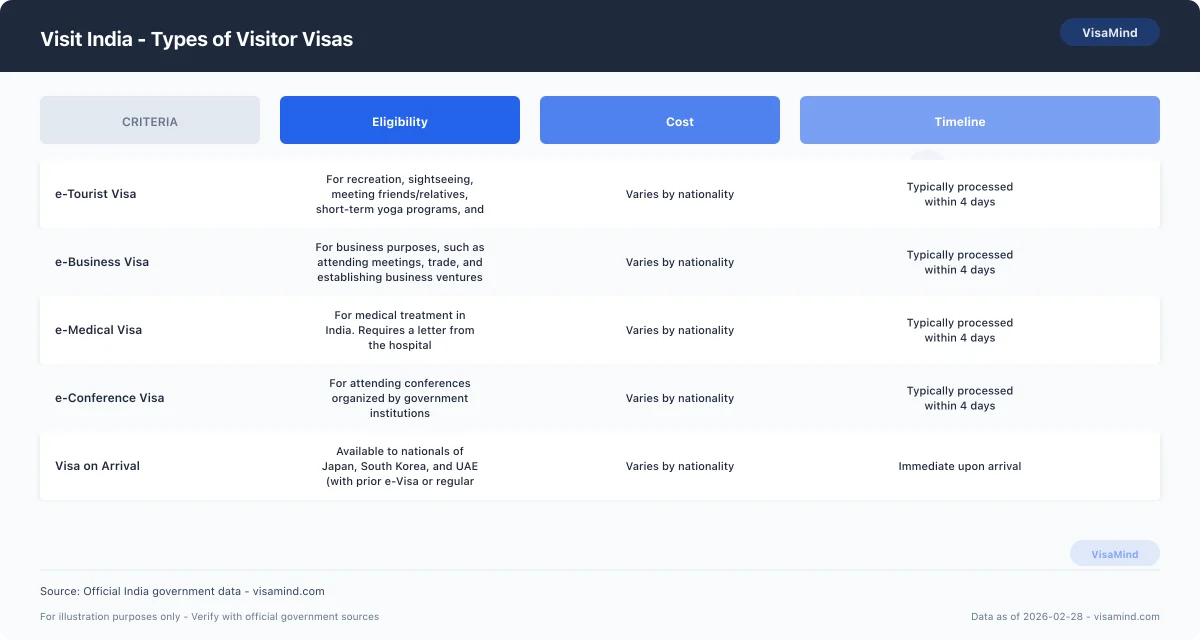
India offers a variety of visitor visas catering to different purposes of travel, such as tourism, business, medical, and conferences. Below is a comparison of the key types of visitor visas available for traveling to India:
| Visa Type | Eligibility | Cost (USD) | Timeline (Processing Time) |
|---|---|---|---|
| e-Tourist Visa | Nationals of eligible countries for tourism, sightseeing, and casual visits | Varies | Typically 3-4 days |
| e-Business Visa | Eligible nationals attending business meetings, trade fairs, or conferences | Varies | Usually processed within 3-4 days |
| e-Medical Visa | Foreign nationals seeking medical treatment in reputed/recognized hospitals | Varies | Approximately 3-4 days |
| e-Conference Visa | For attending conferences organized by government bodies | Varies | Around 3-4 days |
| Visa on Arrival | Available only to nationals of Japan, South Korea, and UAE under specific conditions | Varies | Issued upon arrival |
Key Differences
The e-Tourist Visa is suitable for those looking to explore India's rich cultural heritage, engage in recreational activities, or visit family and friends. It allows a stay of up to 180 days in a year, with no requirement for registration if the stay is less than 180 days.
For business travelers, the e-Business Visa facilitates participation in business activities, such as meetings, conferences, and workshops. Applicants need to present a business card or an invitation letter from an Indian organization.
The e-Medical Visa is designed for patients seeking medical treatment in India. It requires a letter from a recognized hospital. Accompanying attendants can apply for an e-Medical Attendant Visa, limited to two per patient.
The e-Conference Visa is issued for attending official conferences and requires an invitation and political clearance. This visa type is specific to events organized by government entities.
Important: The Visa on Arrival is available only under certain conditions and is limited to nationals of Japan, South Korea, and the UAE. Ensure you check your eligibility and the specific requirements before traveling.
Additional Considerations
All e-Visas require applicants to have a passport with at least six months validity and two blank pages at the time of application. It's crucial to apply online and ensure all uploaded documents and photos meet the required specifications to avoid any delays or rejections.
For more detailed information on each visa type, you can refer to the specific pages for E Tourist, E Business, and E Medical. Additionally, understanding the Documents Checklist can help streamline your application process.
Application Checklist
#It's essential to gather the necessary documents and ensure they meet the specific requirements for your e-Visa application. Here's a comprehensive checklist to guide you through the process.
Passport and Personal Documentation
- Valid Passport: Ensure your passport has at least six months of validity from your intended date of arrival in India and contains at least two blank pages.
- Scanned Bio Page of Passport: This should clearly show your photograph and personal details.
Photographs
- Recent Photograph: Provide a recent front-facing photograph with a white background. Make sure the photo meets the specifications outlined on the Documents Checklist.
Financial Proof
- Return or Onward Journey Ticket: You must have a return ticket or an onward journey ticket.
- Proof of Funds: Evidence of sufficient funds to cover your expenses during your stay in India.
Additional Documents Depending on Visa Type
- e-Business Visa: Include a business card or an invitation letter from the Indian company you intend to visit. For more details, refer to the E Business Visa.
- e-Medical Visa: Attach a letter from the hospital in India where you will receive treatment. Check the E Medical Visa section for further guidance.
- e-Conference Visa: Provide an invitation and political clearance from the event organizer.
Important: For those of Pakistani origin or holding a Pakistani passport, the e-Visa option is not available. You must apply for a regular visa through the appropriate Indian mission.
Technological Requirements
- Internet Access: Ensure you have access to a computer with an updated web browser like Mozilla Firefox, Google Chrome, or Internet Explorer version 9.0 and above.
- Adobe Acrobat Reader: Required for viewing and printing application documents. Ensure you have version 7.0 or higher.
Additional Considerations
- Persons of Indian Origin: If you have a canceled or surrendered Indian passport, provide the surrender certificate issued in or after 2010.
- Special Cases: Depending on your nationality, specific instructions and additional documents may be required. It's advisable to check the Visa Refusal Reasons and ensure all your documents align with the guidelines.
Tip: Apply online at least four days before your planned arrival in India to allow sufficient processing time. After submission, you will receive an Electronic Travel Authorization (ETA) via email, which you must print and present upon arrival.
For further details on applying for different visa categories, explore the How To Apply guide to ensure all requirements are thoroughly met before your journey to India.
The Application Process
#Applying Online for an e-Visa
Start your application process by visiting the official e-Visa website. Ensure that your passport has at least six months of validity and two blank pages, as this is a critical requirement. Eligible foreign nationals can apply for various types of electronic visas such as E Tourist and E Medical.
- Upload a recent passport-sized photograph with a white background.
- Scan and upload the bio page of your passport showing your photo and details.
- Complete the online application at least 4 days before your intended arrival date in India.
Important: Make sure the documents and photographs you upload are clear and meet the specifications to avoid delays.
Payment and Confirmation
After filling out your application, proceed to pay the e-Visa fee online using a credit or debit card or a payment wallet. It is advisable to make this payment at least 4 days before your travel date to ensure timely processing.
- Upon successful payment, you will receive an Electronic Travel Authorization (ETA) via email.
- Verify that your ETA status is 'GRANTED' before traveling.
Tip: Always use the official e-Visa portal to apply and make payments to avoid scams and ensure your application is processed efficiently.
Receiving and Printing Your ETA
Once you receive your ETA in your email, print a copy to carry with you during your travel. The ETA is a crucial document that you must present at the Immigration Check Post upon arrival in India.
- Ensure the printout is clear and legible.
- Keep the printed ETA with your travel documents to present upon arrival.
Important: Not carrying a printed copy of the ETA can result in entry denial at the border.
Applying Through Indian Embassies or Consulates
If you are not eligible for an e-Visa or prefer applying through traditional means, you can lodge your application at Indian embassies or consulates in your country.
- Schedule an appointment at the nearest Indian mission.
- Prepare all necessary documents, including your passport, photographs, and any additional paperwork specific to your visa type (e.g., business invitation letter for a Business Visa).
For specific visa types that require longer stays, like Student or Employment visas, consult the respective Indian mission for detailed requirements and timelines.
Visiting VFS Centers
If you need assistance with your application, VFS Global centers can provide support services. While they don’t make visa decisions, they can help ensure your application is correctly filled and submitted.
- Make an appointment with a VFS center if you need help with document verification or application submission.
- VFS services may include biometric data collection, if applicable for your visa type.
By following these steps, you can efficiently navigate the process of obtaining a visa to visit India. Remember to check the specific requirements and timelines for your visa category on the official website.
Common Mistakes Visitors Make
#It's crucial to be aware of common mistakes that can disrupt your travel plans. Here are some pitfalls to avoid:
Overstaying Your Visa
- 180-Day Limit: Visitors on a one-year or five-year Tourist Visa must not exceed a 180-day stay per visit. If you plan to stay longer, ensure you register with the Foreigners Regional Registration Office (FRRO) within two weeks after reaching this limit.
- Visa Expiry: Always keep an eye on your visa's expiration date. Overstaying can lead to fines, deportation, or future entry bans.
Important: If you intend to extend your stay, consult the Visa Extension Guide for details about the process and required documentation.
Engaging in Prohibited Activities
- Working on a Tourist Visa: Employment is strictly prohibited on a tourist visa. If you wish to work in India, consider applying for an Employment Visa.
- Inappropriate Use of e-Visa: Using an e-Visa for purposes like journalism, NGO activities, or employment is not permitted. Ensure your activities align with your e-Visa type.
Financial Requirements
- Insufficient Funds: Ensure you have proof of sufficient funds to cover your stay in India. This may include bank statements or a credit card.
- Return Ticket: Keep a copy of your return or onward journey ticket. It's a common requirement at immigration checkpoints.
Tip: Verify the specific financial requirements for your visa type on the Financial Requirements page.
Document and Application Errors
- Passport Validity: Your passport must have at least six months of validity from the application date. Ensure it has two blank pages for visa stamps.
- Clear Documentation: Upload clear and correct documents and photos in your e-Visa application. Blurry or incorrect uploads can result in delays or rejection.
By avoiding these common mistakes, you can help ensure a smooth and enjoyable visit to India. For more details on visa types, such as the E Tourist Visa or E Conference Visa, explore our guides.
Arriving and Clearing Customs
#Upon arriving in India, you will go through immigration clearance where several procedures are in place to ensure a smooth entry process. Here’s what you can expect:
Immigration Procedures
At the immigration checkpoint, you will need to present your passport along with the Electronic Travel Authorization (ETA) you received for your e-Visa. Ensure that your passport has at least six months of validity and two blank pages. The Bureau of Immigration is responsible for processing your entry, so having all documents ready will expedite this process.
Key Documents to Present:
- Passport with at least six months validity
- Printed copy of your ETA
- Return or onward journey ticket
- Proof of sufficient funds for your stay
Fingerprinting and Photographs
As part of the immigration process, biometric data such as fingerprints and photographs will be taken. This is a standard procedure for all foreign nationals entering India on an e-Visa. Ensure your hands are clean and free of any substances that might interfere with fingerprint scanning.
Interviews and Additional Checks
In some cases, immigration officers may conduct brief interviews to confirm the purpose of your visit. Be prepared to answer questions related to your travel plans, such as your accommodation details and itinerary.
Possible Interview Questions:
- What is the purpose of your visit?
- How long do you intend to stay in India?
- Where will you be staying during your visit?
Tip: Be honest and concise in your responses to avoid any delays in the process.
E-Gates for Entry
Some Indian airports offer e-Gates for faster processing of travelers holding e-Visas. These automated gates use electronic systems to verify your travel documents and biometric data, expediting your entry into the country. If you are eligible to use e-Gates, follow the signage and instructions at the airport to take advantage of this service.
Important Considerations
- Registration: If your stay exceeds 180 days, you are required to register with the Foreigners Regional Registration Office (FRRO) within two weeks after the 180-day period.
- Visa Conditions: Ensure that your activities in India align with the conditions of your e-Visa type, whether it be Tourist or E Conference.
By preparing ahead and understanding the procedures at Indian immigration, you can ensure a smooth entry into the country. For more details on planning your visit, refer to the How To Apply guide.
Extending Your Stay
#If you find yourself enchanted by the vibrant culture of India and wish to extend your stay, you may be eligible to apply for an extension of your e-Visa. The process for extending your visa is managed by the Foreigners Regional Registration Office (FRRO), which is the primary authority for handling visa extensions and foreigner registration within India.
Are Extensions Possible for All Visitors?
Extensions are typically possible for certain types of visas, but you must ensure your request aligns with Indian regulations. For instance, e-Tourist Visas and e-Business Visas are usually eligible for extensions, subject to specific conditions. However, it is important to note that extensions are not universally available for all visa types. For instance, e-Medical Visas may have different stipulations, so always verify your eligibility according to your specific visa type. For more details on different visa types, you can refer to the E Tourist Vs Tourist guide.
How to Apply for an Extension
To initiate an extension, you must apply through the FRRO's online portal. Here is a general outline of the steps involved:
- Log in to the FRRO portal: Begin by accessing the official FRRO website and creating an account if you don't already have one.
- Fill in your details: Complete the online application form with accurate information about your current visa and the duration for which you seek an extension.
- Upload necessary documents: You will need to provide supporting documents, such as your passport, current visa, and a letter explaining your reasons for the extension.
- Pay the applicable fee: The portal will prompt you to pay the necessary fee online. Always check the current fee structure as it may change.
- Await approval: Once submitted, the FRRO will review your application, and you will receive a notification of the decision.
Important: Ensure you apply for an extension well before your current visa expires to avoid any overstay penalties.
What to Do After Your Extension is Granted
Upon approval, your visa will be updated with the new expiry date. Make sure to download the updated visa document and keep a copy with you at all times during your stay. It's crucial to respect the new visa terms and conditions to avoid any legal issues.
For comprehensive guidance on the visa extension process, including detailed instructions and potential pitfalls, visit the Visa Extension Guide. This resource will help you navigate the extension process smoothly and ensure compliance with all necessary regulations.
Lessons from Real Applications
#A business professional from France planned to attend a major conference in New Delhi, but he realized at the last minute that he had not applied for the necessary visa. Understanding his eligibility for the e-Conference Visa, he promptly accessed the official e-Visa website to begin the application process. He uploaded the required documents, including an invitation from the conference organizers and a political clearance letter, and paid the visa fee online. Within 72 hours, he received the Electronic Travel Authorization (ETA) via email. Upon arriving in India, he presented the printed ETA at the immigration check post, where the e-Visa was stamped on his passport. This efficient process enabled him to attend the conference without any issues.
Scenario: Yoga Enthusiast Enrolling in a Short-term Program
An American yoga enthusiast wanted to enroll in a short-term yoga program in Rishikesh. She decided to apply for an e-Tourist Visa, which suited her purpose of recreation and learning. She ensured her passport had over six months of validity and applied four days in advance via the e-Visa portal. After submitting her recent photograph and a scanned copy of her passport's bio page, she paid the visa fee using her credit card. Her ETA was granted within a few days. She printed the ETA and, upon arrival at the Indian airport, presented it to immigration officials. Her e-Visa was successfully stamped, allowing her to enjoy her yoga retreat.
Scenario: Medical Tourist Seeking Treatment in India
A patient from the United Kingdom required medical treatment in India and intended to apply for an e-Medical Visa. He coordinated with an Indian hospital, which provided an admission letter necessary for the visa application. Using the e-Visa portal, he submitted his application alongside the hospital's letter and proof of financial means to cover his stay. He also ensured that his passport was valid for at least six months. The application was processed promptly, and he received his ETA within a week. On arriving in India, his e-Visa was stamped at the immigration check post, allowing him to proceed with his medical treatment without delays.
FAQs
What are common mistakes to avoid when applying for a Visit India e-Visa?
Can I switch from a Visit India Tourist Visa to a Business Visa?
What are the requirements for a Visit India e-Business Visa?
Can I work in India on a Visit India e-Tourist Visa?
How does the FRRO assist in the Visit India visa process?
Can I combine tourism and medical treatment on a Visit India e-Visa?
What is the timeline for receiving an e-Visa for a Visit India trip?
Sources
Last reviewed: March 1, 2026
VisaMind provides informational guidance only and is not a government agency. This is not legal advice. Requirements can change and eligibility depends on your specific facts. If your case is complex or high-stakes, consult a licensed immigration attorney.
Next steps
Requirements vary by nationality, purpose, timeline, and case details. Use Find My Visa to get a personalized checklist for India with official sources and deadlines.
Find my visa