Official sources referenced
When to Read This
#Navigating the Indian visa system can be complex, especially when distinguishing between the Employment Visa and the Project Visa. As of 2023, it's crucial to understand that these visas cater to different professional objectives and requirements. This section is particularly useful for individuals and employers seeking clarity on which visa type best suits their situation, whether for long-term employment or short-term project assignments in India.
Who Needs This Information?
If you are an employer planning to hire foreign nationals for work in India, or an international professional aiming to work on Indian soil, this comparison will help you determine the most appropriate visa type. The Employment Visa is intended for foreign nationals who are employed by an Indian company or multinational corporation and require a longer tenure in the country. In contrast, the Project Visa is designed for foreign nationals involved in specific projects in sectors like power or steel.
Key Considerations
Understanding the distinct purposes of these visas will aid in making an informed decision. The Employment Visa can be more suitable for ongoing roles in various fields, such as IT or finance, where the employee might need to stay and work in India for several years. Meanwhile, the Project Visa is typically limited to the duration of a specific project, often not exceeding 12 months, and is closely tied to the project's completion timeline.
Important: Choosing the wrong visa type can lead to complications with the Foreigners Regional Registration Office (FRRO) during your stay. Ensure your application aligns with your employment terms to avoid unnecessary issues.
For more detailed guidance on visa applications and document requirements, explore our How To Apply and Documents Checklist resources. Additionally, visiting the Employment Visa and Project Visa pages will give you more insight into each visa type.
Side-by-Side Comparison
#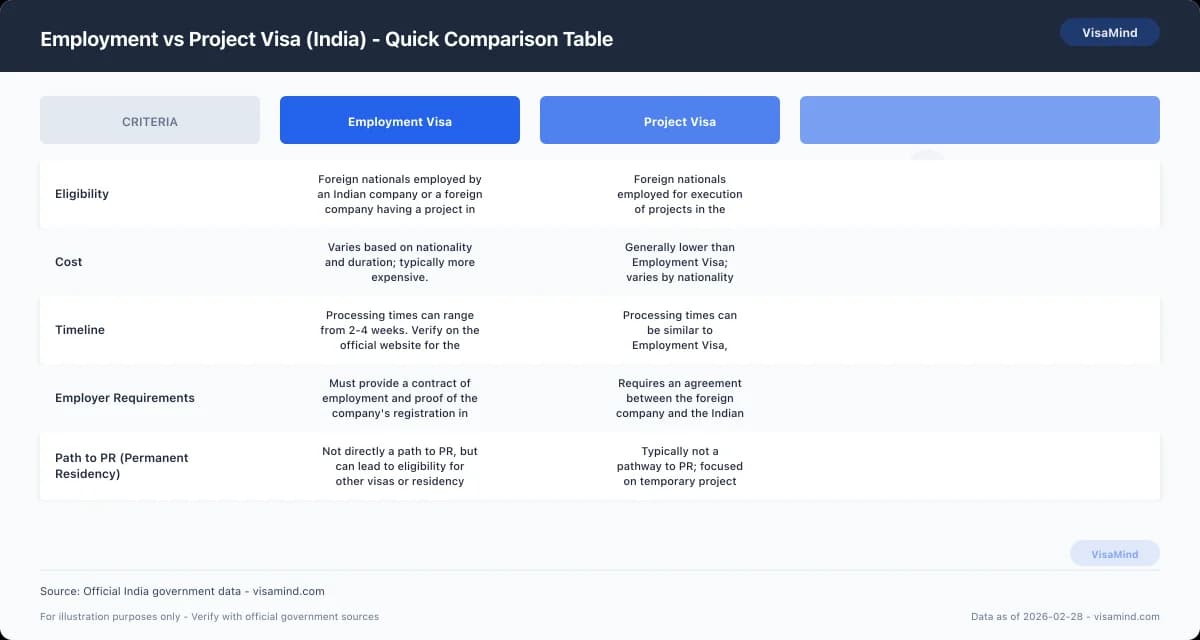
You have two primary visa options: the Employment Visa and the Project Visa. This section provides a side-by-side comparison, helping you understand key differences and determine which visa best suits your needs.
Side-by-Side Comparison
| Dimension | Employment Visa | Project Visa |
|---|---|---|
| Eligibility | For skilled professionals employed by an Indian company or organization. | For foreign nationals involved in specific projects in the power and steel sectors. |
| Cost | Varies by nationality; typically $200-300 USD. | Varies by nationality; typically $100-250 USD. |
| Timeline | Processing can take 2-4 weeks. | Usually processed within 2-4 weeks. |
| Employer Requirements | Employer must be a registered entity in India and provide a contract. | Project employer in India must be a public sector company or a private company with government clearance. |
| Path to PR | Can lead to long-term residency options, though not directly linked to PR. | Does not typically lead to permanent residency. |
Eligibility Requirements
The Employment Visa is designed for skilled professionals who have been offered a job by an Indian organization. This visa often requires proof of qualifications and a formal employment contract with an Indian company. On the other hand, the Project Visa is specific to foreign nationals working on projects in the power and steel sectors, usually on projects commissioned by the Indian government or public-sector undertakings.
Tip: Ensure your employer is aware of the exact visa requirements and provides all necessary documentation to avoid delays.
Cost Implications
Visa fees vary depending on your nationality and the type of visa. As of 2023, an Employment Visa typically costs between $200-300 USD, while a Project Visa is slightly cheaper, ranging from $100-250 USD. Always verify the current fees on the official website before applying as these may change.
Processing Timeline
Both visas generally have a processing timeline of 2-4 weeks. Delays can occur if additional documentation is required, so it's essential to have all paperwork ready. For more information on timelines, you can refer to the Processing Times guide.
Employer Requirements
Employers play a crucial role in both visa applications. For an Employment Visa, your employer must be a legally registered company in India and should provide a valid contract. For a Project Visa, the project must be approved by relevant Indian authorities, and the employer should have government clearance.
Path to Permanent Residency
While the Employment Visa may open paths to long-term residency, it is not a direct route to permanent residency (PR). In contrast, the Project Visa generally does not lead to PR, as it is intended for temporary project-based work.
For further assistance on applying for these visas, you can explore our How To Apply guide and check the Documents Checklist for detailed requirements.
When to Pick the First Option
#A project manager from a multinational construction company was tasked with overseeing a major infrastructure project in Mumbai. The nature of his role required him to be on-site to coordinate with local teams and ensure the project adhered to the planned timelines. Given the project's duration and the necessity for hands-on involvement, he opted for an Employment Visa rather than a Project Visa.
To align with India's immigration requirements, he liaised with his company's HR department to gather all necessary documentation, such as his employment contract and proof of the project's significance to the Indian economy. He submitted these to the Indian embassy in his home country. The embassy processed his application, and within a few weeks, he received his visa, allowing him to manage the project efficiently in Mumbai.
Scenario: IT Specialist Consulting on a Long-Term Software Rollout
An IT specialist was contracted by a large Indian tech firm to assist with the rollout of a new software system across their branches. The project was expected to span over a year, requiring his expertise on-site to train staff and troubleshoot issues as they arose. In this case, an Employment Visa was the more suitable option, as it allowed for a longer stay and covered the nature of his work.
The specialist applied through the Bureau of Immigration portal, providing evidence of his contract and the project's extensive timeline. After verifying that all documents met the requirements, the immigration authorities granted his visa. This enabled him to enter India and work closely with the local team, ensuring the project's success.
Scenario: Research Scientist Collaborating on a Joint Initiative
A research scientist was invited to collaborate on a joint initiative between her home university and an Indian research institute. The project involved extensive fieldwork and collaboration with Indian counterparts over an extended period. She needed a visa that would allow her to participate fully in this collaborative research effort.
Choosing the Employment Visa, she applied through the appropriate channels, presenting her invitation letter, details of the research project, and proof of her role's importance. The Foreigners Regional Registration Office (FRRO) ensured her application was processed smoothly, granting her the necessary visa to contribute her expertise to the research initiative.
Choose Option B If...
#An infrastructure expert from South Korea was offered a six-month contract to oversee the installation of a new railway system in India. He evaluated his visa options and decided that the Project Visa was the most suitable for his needs. The Project Visa is specifically designed for individuals involved in power and steel sector projects, which aligned with his work on infrastructure.
To proceed, he approached the Bureau of Immigration through the official portal to apply for the Project Visa, ensuring he provided all necessary documentation, including the contract details and project specifications. The application process involved liaising with his employer in India to gather the required project approvals and endorsements from relevant Indian authorities. Within a month of submitting his application, he received his Project Visa, allowing him to enter India and commence his work on the railway system without any hitches.
Scenario: IT Professional Moves to India for a Job
An IT professional from Canada secured a job with an Indian tech company in Bengaluru. As his role required an extended stay, he opted for an Employment Visa. This visa type is designed for foreign nationals who have been offered a position by an Indian company and require a long-term stay.
He began by applying for the Employment Visa through the Indian consulate in his home city. The process required a detailed employment contract and a letter of intent from his Indian employer, which was crucial for visa approval. Additionally, the company assisted him in ensuring all documentation met the Foreigners Regional Registration Office (FRRO) standards. After approximately four weeks, the visa was granted, allowing him to move to India and start his new role.
Scenario: Construction Engineer on a Temporary Assignment
A construction engineer from Brazil was contracted for a four-month assignment to work on a new luxury hotel project in Mumbai. Given the short duration and the nature of his involvement, the Project Visa was deemed the appropriate choice. The Project Visa is tailored for specific project-based work, particularly in sectors such as infrastructure and construction.
With assistance from the project’s Indian contractor, he applied for the visa, submitting a comprehensive package that included a letter from the host company detailing the project and his role. The application was lodged through the Bureau of Immigration’s online platform. The visa was approved in about three weeks, enabling him to travel to India and contribute his expertise to the project promptly.
Important: Utilizing the correct visa type not only ensures compliance with immigration laws but also streamlines your entry into India, allowing you to focus on your professional commitments.
Key Differences Explained
#Understanding the distinction between an Employment Visa and a Project Visa is essential. These visas cater to different employment needs and have specific eligibility criteria and requirements.
Purpose and Eligibility
The primary distinction between these two visas lies in their intended purpose and eligibility criteria. The Employment Visa is designed for foreign nationals who intend to work in India at a regular job, typically within an Indian company, or as a specialist in a specific field. This visa is appropriate for roles such as managerial, executive, or other skilled positions. To be eligible, applicants must demonstrate that their skills are essential and not readily available in the Indian labor market.
In contrast, the Project Visa is specifically tailored for foreign nationals working on projects in the power and steel sectors. This visa is project-specific and is usually granted to those who are involved in the execution of projects funded by Indian companies. The visa is tied to the duration of the project rather than a fixed employment term.
Duration and Extension
The duration of stay is another crucial differentiating factor. Employment Visas are generally granted for one year or the term of the contract, whichever is less, and can be extended in India by the Foreigners Regional Registration Office (FRRO). The possibility of extension makes this visa suitable for those looking to settle in India for a longer period.
Project Visas, however, are typically issued for the duration of the project or for one year, whichever is less, with a possibility of extension depending on the project's completion timeline. Extensions are less common with Project Visas, as they are closely tied to the specific project timeline.
Employment Relationship and Restrictions
The nature of the employment relationship also varies between these visas. With an Employment Visa, there is a direct employer-employee relationship, and the visa holder is considered part of the company's workforce. This involves receiving a regular salary and benefits as per Indian labor laws.
For a Project Visa, the relationship is more contractual, with the visa holder often contracted through a foreign company for the specific project in India. This visa does not allow for a change in employment to a different project or role without exiting India and applying for a new visa.
| Factor | Employment Visa | Project Visa |
|---|---|---|
| Purpose | Regular employment in India | Project-specific in power/steel |
| Eligibility | Skilled, managerial, executive roles | Project-related roles |
| Duration | One year or contract term | Project duration or one year |
| Extension | Possible through FRRO | Limited, project-dependent |
| Employment Relationship | Direct employer-employee | Contractual, project-based |
Tip: If your stay in India requires frequent travel in and out of the country, ensure that your visa type allows for multiple entries, as some visas may have restrictions.
Understanding these key differences can guide you in selecting the right visa type based on your work requirements in India. For more detailed application procedures, you can refer to the How To Apply and Documents Checklist guides.
What People Get Wrong
#-
Assuming Any Work Visa Will Suffice: A common misconception is that any work-related visa, such as the Employment Visa, can cover all types of work in India. However, specific projects tied to Indian companies or sectors such as power and steel often require a Project Visa.
-
Overlooking Specific Requirements: Many overlook that the Project Visa is intended for foreign nationals coming to India for executing projects in the power and steel sectors. The Employment Visa, on the other hand, is broader and can be used for various employment types across sectors.
Confusion About Application Process
-
Mixing Up Agencies: Some applicants mistakenly believe that the Foreigners Regional Registration Office (FRRO) handles visa issuance. In reality, the Bureau of Immigration (BOI) manages entry and exit processes, while Indian missions abroad handle visa issuance.
-
Documents Misunderstanding: There's a misconception that the same documents are needed for both visas. While both require basic identification documents, a Project Visa might demand additional project-specific documentation.
Duration and Extensions
-
Incorrect Assumptions About Duration: It is often assumed that the duration and extension options for Employment Visa and Project Visa are the same. In reality, these can vary significantly based on the specifics of the project or employment contract.
-
Ignoring the Role of FRRO for Extensions: Many applicants fail to recognize that while the BOI handles initial visa issuance, the FRRO is responsible for managing visa extensions and registrations within India.
Important: Always verify the specific visa type requirements and processes on the official Bureau of Immigration website to ensure compliance and avoid application delays.
Can You Switch Later?
#Switching between an Employment Visa and a Project Visa in India is an option available to some individuals, but the process can be complex and requires meeting specific criteria set by the Indian immigration authorities.
How to Switch Between Visas
To transition from an Employment Visa to a Project Visa or vice versa, you must follow the procedures outlined by the Foreigners Regional Registration Office (FRRO). This process involves applying for a visa conversion and demonstrating the necessity for the switch.
-
Eligibility Assessment: Ensure that you meet the eligibility criteria for the new visa type. For example, a Project Visa is typically meant for individuals engaged in specific projects in the power and steel sectors, while an Employment Visa is for foreign nationals employed by an Indian company.
-
Document Preparation: Gather the necessary documents such as a valid passport, current visa, proof of employment or project engagement, and any additional documentation required by the FRRO.
-
Application Submission: Lodge an application with the FRRO for visa conversion. This may include an in-person appointment where you present your documents and explain the need for the visa change.
-
Await Approval: The FRRO will review your application and decide based on the information provided. Approval is not guaranteed and is subject to the discretion of the immigration authorities.
Key Considerations
-
Duration and Purpose: The intended duration of stay and the specific nature of your work or project in India are crucial factors in determining the approval of a visa switch.
-
Employer/Project Sponsor Letter: A letter from your current employer or project sponsor explaining the reasons for the visa switch can strengthen your application.
Important: Changes to your visa status can affect your legal standing in India. It is advisable to consult with immigration experts or legal counsel to ensure compliance with all requirements.
Possible Challenges
-
Processing Time: The processing time for visa conversions can vary. It is advisable to apply well in advance of your current visa's expiry. For more information on timelines, refer to the Processing Times guide.
-
Approval Uncertainty: The FRRO has the discretion to accept or reject visa conversion applications. Ensure that all documentation is accurate and complete to improve your chances of approval.
Understanding the nuances of switching between an Employment Visa and a Project Visa can save you time and effort. For further guidance, explore resources like the Visa Extension Guide to understand how extensions might affect your visa status.
Who Chose What and Why
#An IT project manager from Germany was tasked with overseeing a critical software development project for a client in India. His company had a short-term contract with an Indian firm, which required him to travel to India for six months. Since the project involved direct execution and on-site supervision, he needed to determine whether an Employment Visa or a Project Visa was more suitable.
After consulting with the Indian consulate and reviewing the Project Visa requirements, he realized that since his assignment was specifically linked to a project contract between the two companies, the Project Visa was the appropriate option. He submitted the necessary documents, including the project's contract details and his employment verification, through the Bureau of Immigration's online portal. Within three weeks, his visa was approved, allowing him to focus on his project without any immigration hurdles.
Scenario: Construction Engineer Assigned to a Long-term Infrastructure Project
A construction engineer from South Africa was selected to join a long-term infrastructure project in India, aimed at building a new transportation hub. His role required him to be in India for over a year, working closely with the Indian team to ensure the quality and safety of the construction. Given the duration and nature of his work, he faced a choice between applying for an Employment Visa and a Project Visa.
He consulted with his company's HR department, which had experience in similar deployments, and they advised him to apply for the Employment Visa. This was due to the prolonged duration and his employment with the Indian subsidiary. He followed the application process outlined by the Indian embassy, providing documents like his employment contract, educational qualifications, and a letter from the Indian company. After a month of processing, he received his visa, securing his position in India for the project's entire duration.
Tip: When unsure about the appropriate visa type for assignments in India, consulting with the Indian consulate or an experienced immigration advisor can help ensure you apply for the correct visa category.
FAQs
Are there any salary requirements for obtaining an Employment Visa in India?
Is it possible to combine purposes on an Employment Visa in India?
What documents are required for applying for a Project Visa in India?
How does the FRRO handle Employment Visa applications for Persons of Indian Origin?
Can you extend a Project Visa in India?
What mistakes do people commonly make when applying for an Employment Visa in India?
How long is the india-employment-vs-project-visa form valid for submission?
Sources
Last reviewed: March 1, 2026
VisaMind provides informational guidance only and is not a government agency. This is not legal advice. Requirements can change and eligibility depends on your specific facts. If your case is complex or high-stakes, consult a licensed immigration attorney.
Next steps
Requirements vary by nationality, purpose, timeline, and case details. Use Find My Visa to get a personalized checklist for India with official sources and deadlines.
Find my visa