Official sources referenced
Is This Comparison for You?
#For students planning to study in the UK, the Student visa and the Short-term Study visa are two distinct options, each catering to specific needs and circumstances. If your course lasts longer than six months or you intend to pursue higher education, the Student visa is likely your best choice. This visa allows you to stay in the UK for the duration of your course, which can be up to five years for degree-level study. Applicants must have a confirmed offer from a licensed sponsor and demonstrate English language proficiency.
In contrast, the Short-term Study visa is designed for those undertaking short courses, such as English language programs, lasting up to six months, or up to 11 months for English language courses specifically. This visa does not permit work or extend beyond the initial course duration, making it ideal for those with temporary study plans.
Who Benefits from This Comparison?
This comparison is particularly beneficial for individuals uncertain about which visa aligns with their study goals in the UK. The Student visa offers a more comprehensive solution for longer courses and higher education pursuits. It provides the opportunity to work part-time during term and full-time during breaks, enhancing your experience and financial support while studying. On the other hand, the Short-term Study visa is suitable for those who are clear about returning home immediately after completing a short course and do not require work privileges.
Tip: Carefully evaluate your course length and future aspirations to choose the most appropriate visa. Verify details with the UKVI to ensure the latest information on requirements and timelines.
For more detailed information about each visa type, you can explore the Student Visa and Short-term Study Visa pages. Understanding which visa best fits your needs can significantly impact your study experience in the UK.
At a Glance
#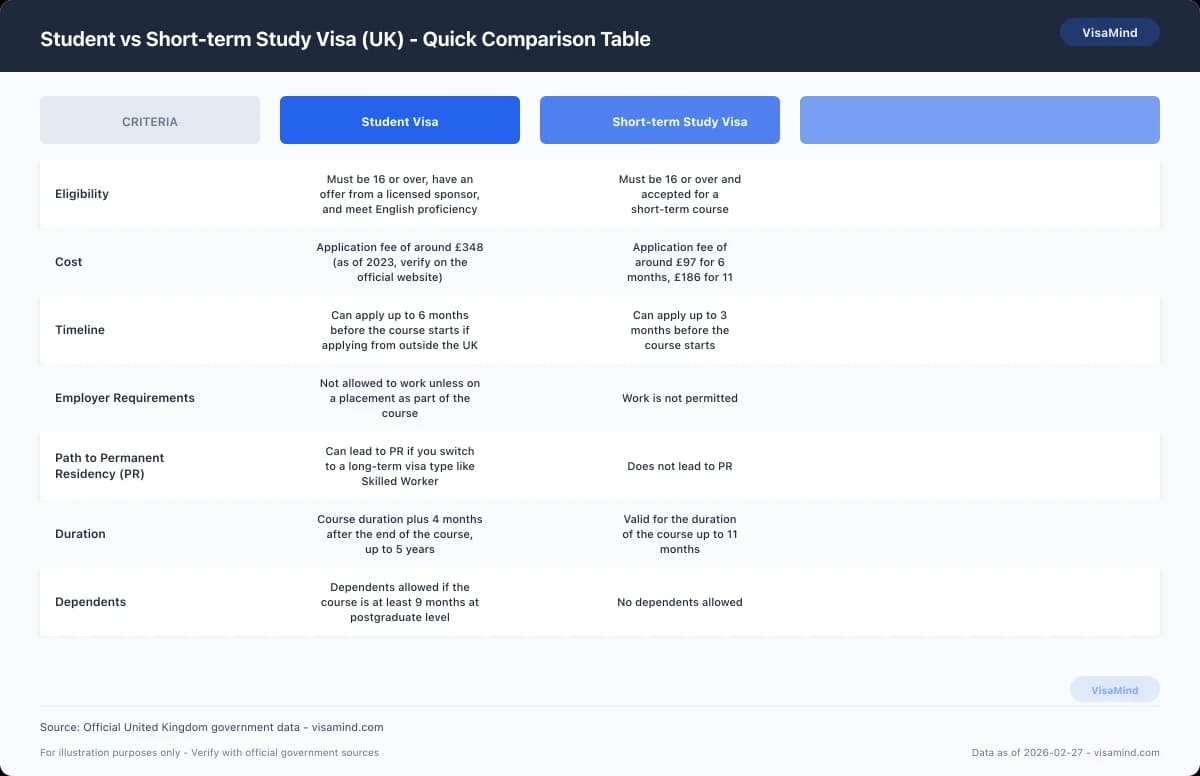
| Aspect | Student Visa | Short-term Study Visa |
|---|---|---|
| Eligibility | Must be 16 or over, have a course offer from a licensed sponsor, prove English proficiency, and demonstrate financial capability. Parental consent required if under 18. | Available for those undertaking short-term courses up to 6 months (or 11 months for English language courses). No specific age requirement. |
| Cost | Approximately £363 as of 2023. Check the official website for updates. | Approximately £200 as of 2023. Verify the fee on the official website. |
| Timeline | Apply up to 6 months before the course starts. Processing typically takes 3 weeks if applying from outside the UK. | Apply up to 3 months before travel. Processing usually takes 3 weeks. |
| Path to Permanent Residency (PR) | Does not directly lead to PR. However, Graduate Visa is an option post-studies to remain in the UK and possibly transition to other visas that lead to PR. | Does not lead to PR. This visa is strictly for short-term study and cannot be extended or transitioned to a Student Visa. |
| Employer Requirements | Not applicable. Part-time work is allowed during studies, typically up to 20 hours per week during term time. | Not applicable. Work is not permitted under this visa. |
Key Considerations
When deciding between a Student Visa and a Short-term Study Visa, it's crucial to consider your study duration and long-term plans in the UK. The Student Visa offers more flexibility, including part-time work opportunities and potential paths to extend your stay, such as through the Graduate Visa. In contrast, the Short-term Study Visa is suitable for those with specific short-term study needs without the intention of long-term residency or employment in the UK.
Important: Ensure you meet all eligibility requirements, especially financial and English proficiency criteria, to avoid application issues.
For more information on visa options and guidance tailored to your situation, you can explore related guides like the Visa Extension Guide and PR Pathway Guide.
Option A Is Better When...
#A 19-year-old student from India wanted to pursue a bachelor's degree in engineering at a prestigious UK university. She received an offer from a licensed sponsor and eagerly started planning her move. To secure her place, she opted for a Student Visa, which was more suitable for her long-term academic goals.
To apply, she needed to demonstrate her English proficiency through an approved test and show evidence of her financial capability to cover tuition and living expenses. She also had to apply for the visa from outside the UK, adhering to the requirement to initiate the process up to six months before her course began. After setting up a UKVI account to manage her application, she successfully obtained her visa. Once she arrived in the UK, she was able to enjoy the benefits of a Student Visa, which included the ability to work part-time during term and full-time during holidays, enhancing her educational and cultural experience.
Scenario: Transitioning from a Short Course to a Degree Program
A 25-year-old professional from Brazil initially came to the UK on a Short-term Study Visa to attend a six-month English language course. During his stay, he decided to further his education by enrolling in a master's program in business management. Recognizing that a Short-term Study Visa wouldn't suffice for his new academic path, he transitioned to a Student Visa.
He needed to secure a course offer from a licensed sponsor and fulfill the financial and English proficiency requirements. Applying for the Student Visa involved proving his identity and ensuring his application was lodged at least 28 days before his Short-term Study Visa expired. This seamless transition allowed him to continue his studies without interruption and provided him with the opportunity to work part-time, which was not permitted under his previous visa. The successful switch ensured he could remain in the UK for the duration of his degree program.
Scenario: Studying in the UK as a Minor
A 17-year-old high school student from China received an offer to study at an independent school in the UK. Since he was under 18, parental consent was required as part of his Student Visa application. His parents provided the necessary consent documents, and he demonstrated his English language proficiency and financial capability to support his studies.
By applying for the Student Visa, he gained the flexibility needed to study for an extended period and even considered applying for a Child Student Visa since it specifically caters to students attending independent schools. The process was smooth, and he was able to start his school year on time, enjoying the comprehensive educational opportunities the UK had to offer.
When to Pick the Second Option
#A freelance graphic designer wanted to improve her English language skills to expand her international client base. She found a three-month intensive language course at a reputable language school in London. Given the short duration of her studies, she decided to apply for a Short-term Study Visa.
She prepared her application by gathering proof of acceptance from the language school and demonstrating that she had enough funds to cover her stay without working in the UK. She applied through the official UKVI portal and was granted her visa within three weeks. The visa allowed her to focus solely on her studies without the need to prove English proficiency or secure a licensed sponsor, which are requirements typically associated with a Student Visa.
Scenario: Summer Program at a UK University
An undergraduate student from India received an offer to attend a two-month summer program at a university in Edinburgh. Since the program was short and she would not be earning credits towards her degree, she opted for the Short-term Study Visa. This visa option was more suitable because it did not require extensive financial documentation or English language certification, unlike the Student Visa.
She applied online and ensured her application included evidence of her acceptance into the program and sufficient funds to cover her accommodation and living expenses during her stay. The application was processed swiftly, allowing her to join the program on time. This experience enriched her academic profile without the complexities and requirements associated with longer study visas.
Scenario: Professional Development Course
A software engineer based in the United States aimed to attend a professional development course in the UK lasting six weeks. The course was designed to enhance his skills in artificial intelligence, which was crucial for his upcoming project at work. Recognizing the short duration, he applied for a Short-term Study Visa.
The application process was straightforward. He provided proof of enrollment in the course and evidence of his financial capability to sustain himself during his stay. Since the course did not involve a full-time study load or a degree, the short-term visa was the optimal choice. The visa was approved in a month, allowing him to attend the course and return to his job with enhanced skills and knowledge, all without the need for a licensed sponsor or English language testing.
Tip: For short-term courses that do not lead to a degree, the Short-term Study Visa is often the most flexible and efficient option, saving you the complexity associated with longer-term study visas.
What Really Sets Them Apart
#When considering a Student Visa or a Short-term Study Visa for studying in the UK, it's crucial to understand the key differentiators between these options. Each visa serves different purposes and comes with distinct requirements and limitations.
Duration and Purpose of Stay
The Student Visa is designed for those pursuing longer-term studies, typically in further or higher education. It allows you to reside in the UK for the duration of your course, which can extend from several months to several years, depending on the level and length of study. This is ideal if you plan to enroll in a degree course or a similar long-term program.
In contrast, the Short-term Study Visa is tailored for those who intend to undertake short-term study courses in the UK, such as English language courses. This visa is valid for up to 6 months, or 11 months if you are studying an English language course. It's an excellent option for individuals looking to engage in a short educational experience without committing to a lengthy stay.
Eligibility and Requirements
Both visas have specific eligibility criteria, but they vary significantly in terms of requirements:
-
Student Visa Requirements:
- Must be 16 or over and have an offer from a licensed student sponsor.
- Need to demonstrate English language proficiency.
- Must show evidence of financial capability to support yourself and pay for your course.
- If you are 16 or 17, parental consent is required.
-
Short-term Study Visa Requirements:
- You must have been accepted for a short-term course in the UK.
- Proof of funds to cover your stay and return journey is necessary.
- English language proficiency is not a prerequisite for this visa.
Work and Lifestyle Restrictions
A significant difference lies in the work permissions and lifestyle restrictions each visa entails. The Student Visa allows for part-time work during term time and full-time work during holidays, providing a chance to gain work experience in the UK. It may also lead to opportunities to extend your stay, such as transitioning to a Graduate Visa after completing your studies.
Conversely, the Short-term Study Visa does not permit any work, paid or unpaid. This visa strictly limits the holder to study activities and prohibits extending the visa or switching to another visa category while in the UK.
Important: Ensure you have sufficient financial evidence and meet all eligibility criteria before applying for either visa, as failing to do so can lead to a refusal by UK Visas and Immigration (UKVI).
In summary, the choice between a Student Visa and a Short-term Study Visa largely depends on the duration and nature of your intended studies in the UK. For those planning to engage in longer academic courses with the possibility of working and extending their stay, the Student Visa is the appropriate choice. On the other hand, the Short-term Study Visa is suitable for individuals seeking a brief educational experience without the need for work or extended stay provisions. Understanding these differences will help you make an informed decision best suited to your academic and professional goals.
Common Misconceptions
#-
Misconception: Some believe that the Student visa and Short-term Study visa have the same financial requirements.
- Reality: For a Student visa, you must demonstrate sufficient funds to cover your course fees and living expenses, which varies based on your study location in the UK. Conversely, the Short-term Study visa demands proof of funds for the duration of your stay but often involves a shorter timeframe and potentially less financial burden.
-
Misconception: Financial documentation isn’t essential for a Short-term Study visa.
- Reality: Both visas require proof of financial capability. For a Short-term Study visa, you must still show that you can support yourself without needing public funds during your stay.
Course and Sponsorship Requirements
-
Misconception: Any educational institution in the UK can sponsor a Student visa.
- Reality: Only institutions holding a valid sponsor license can provide a Confirmation of Acceptance for Studies (CAS) for a Student visa. For detailed information on eligible institutions, check the Student Visa guidelines.
-
Misconception: You can switch courses freely with a Student visa.
- Reality: Changing courses may require a new application and CAS from a licensed sponsor. This is not a straightforward process and should be carefully considered.
Duration and Validity
-
Misconception: Both visas offer the same duration of stay in the UK.
- Reality: The Student visa typically allows for a longer stay, often covering the duration of the course plus additional time for post-study activities. In contrast, the Short-term Study visa is limited to a maximum of six months (or 11 months for English language courses). For more details, see the Short-term Study Visa section.
-
Misconception: You can extend a Short-term Study visa while in the UK.
- Reality: The Short-term Study visa is not extendable or convertible to another visa type. If you wish to continue studying, you must apply for a different visa from outside the UK.
Important: Traveling to the UK before the start date on your visa can result in entry refusal. Always adhere to the specified start date to avoid complications.
Parental Consent and Age Restrictions
- Misconception: Parental consent is only necessary for applicants under 16.
- Reality: For a Student visa, applicants aged 16 or 17 must provide parental consent. This requirement does not apply to Short-term Study visa applicants, as it is generally intended for adults.
By understanding these key distinctions, you can better navigate the application process and choose the visa that aligns with your study goals in the UK. For further insights on application processes and requirements, visit the How To Apply guide.
Converting Between Options
#When navigating the UK immigration system, you might find yourself needing to switch between a Student Visa and a Short-term Study Visa. Understanding the conversion process is essential to ensure compliance with UK Visas and Immigration (UKVI) requirements.
Can You Convert a Short-term Study Visa to a Student Visa?
Unfortunately, you cannot directly convert a Short-term Study Visa to a Student Visa while being in the UK. If you wish to transition to a Student Visa, you will need to leave the UK and apply from your home country or any other eligible location.
Important: Attempting to switch visas while in the UK without following the correct process can lead to complications or denial of your application.
Converting a Student Visa to a Short-term Study Visa
If you hold a Student Visa and wish to switch to a Short-term Study Visa, it is not possible to make this change while you are in the UK. The Short-term Study Visa is typically intended for courses that are up to six months long (or eleven months for English language courses), and applications must be made from outside the UK.
Steps to Apply for a New Visa
- Plan Ahead: Ensure your new course starts within 28 days of your current visa expiring.
- Prepare Your Documents: Gather necessary documentation, including proof of acceptance from a UK educational institution and evidence of your financial capability.
- Apply from Outside the UK: Submit your application from your home country or another eligible country.
Key Considerations
- Financial Proof: Demonstrate that you have sufficient funds to cover your course fees and living expenses.
- English Proficiency: Provide evidence of your English language skills, if required.
- Parental Consent: If you are under 18, ensure you have parental consent for your study plans.
For more detailed guidance on applying for a new visa, you can refer to our Visa Extension Guide or explore the How To Apply resource.
Tip: Always verify the latest requirements and details on the official UKVI website before proceeding with any visa application.
Real Scenarios
#Maria, a 19-year-old student from Brazil, initially came to the UK on a Short-term Study Visa to attend a 6-month English language course. After successfully completing her course, she decided to pursue a degree in Business Administration at a UK university. To transition to a Student Visa, she first received an unconditional offer from a licensed sponsor university. Maria then had to return to Brazil to apply for her new visa, as the UK does not allow switching from a Short-term Study Visa to a Student Visa while in the UK. She gathered all necessary documents, including proof of financial capability and English proficiency, and lodged her application through the UK Visas and Immigration (UKVI) portal. Within three weeks, Maria received her Student Visa, allowing her to travel back to the UK and start her new academic journey.
Scenario: Parental Consent for a Minor
Elliot, a 17-year-old aspiring artist from Canada, received an offer to study at a prestigious art school in the UK. As he was under 18, he needed parental consent to apply for a Student Visa. Elliot's parents provided a formal consent letter, which was a key requirement in his visa application. They also had to demonstrate that they could financially support Elliot during his studies. Elliot submitted his application through the UKVI portal, ensuring all documents were in order, including proof of his English language skills. After a tense wait of four weeks, Elliot was granted his visa, and he eagerly prepared for his move to the UK to join the vibrant art community.
Scenario: Financial Capability Concerns
Anisa, a 20-year-old aspiring engineer from India, applied for a Student Visa to study mechanical engineering at a renowned UK university. Her initial application was refused due to insufficient evidence of financial capability. Anisa was determined to address this issue and reapply. She consulted with her university's international student office, which provided guidance on the specific financial documents required by UKVI. Anisa included a detailed bank statement and a letter from her sponsor confirming the availability of funds. She resubmitted her application through the UKVI portal. This time, her application was successful, and she received her visa approval within four weeks, allowing her to commence her studies as planned.
FAQs
How does UKVI evaluate financial requirements for Student vs Short-term Study Visa (UK)?
Can I work in the UK on a Student vs Short-term Study Visa (UK)?
Are there English language requirements for both Student vs Short-term Study Visa (UK)?
What are the key eligibility differences between a Student vs Short-term Study Visa (UK)?
How long before my course can I apply for a Student Visa in the UK?
What happens if I apply too late for a Student vs Short-term Study Visa (UK)?
Can I begin a new course on a Student Visa if my current visa is about to expire?
Sources
Last reviewed: March 2, 2026
VisaMind provides informational guidance only and is not a government agency. This is not legal advice. Requirements can change and eligibility depends on your specific facts. If your case is complex or high-stakes, consult a licensed immigration attorney.
Next steps
Requirements vary by nationality, purpose, timeline, and case details. Use Find My Visa to get a personalized checklist for United Kingdom with official sources and deadlines.
Find my visa