Official sources referenced
When to Read This
#Japan's Working Holiday Visa program offers a unique opportunity for young people from partner countries to explore Japan while engaging in incidental work to fund their travels. This visa is available to individuals aged 18 to 30, with a few exceptions allowing applications up to age 25, depending on nationality. In contrast, the Student Visa is designed for those who intend to pursue education in Japan, necessitating enrollment in a recognized educational institution. Both options serve distinct purposes and cater to different goals, making it essential to understand which aligns better with your aspirations.
Who Should Consider This Comparison?
This comparison is particularly beneficial for those under 30 contemplating a temporary stay in Japan. If you're evaluating whether to immerse yourself in Japanese culture through work and travel or to pursue academic studies, understanding the differences between these visas is crucial. The Working Holiday Visa might appeal to those seeking flexibility and cultural exchange, whereas the Student Visa suits those committed to academic growth.
Key Considerations
- Eligibility and Purpose: The Working Holiday Visa emphasizes cultural exchange and allows for short-term employment, while the Student Visa focuses on academic pursuits.
- Financial Requirements: Both visas necessitate proof of funds, but the specifics vary. For the Working Holiday Visa, you must demonstrate enough funds for maintenance and a return ticket, while the Student Visa may require proof of tuition payment and living expenses.
Tip: Carefully assess your primary goal—be it travel and work or formal education—as this will guide your visa choice. For more detailed insights into each visa type, refer to the Working Holiday Guide and the Student Visa information page.
By understanding these fundamental differences, you can make an informed decision that best suits your objectives and ensures a fulfilling experience in Japan.
Side-by-Side Comparison
#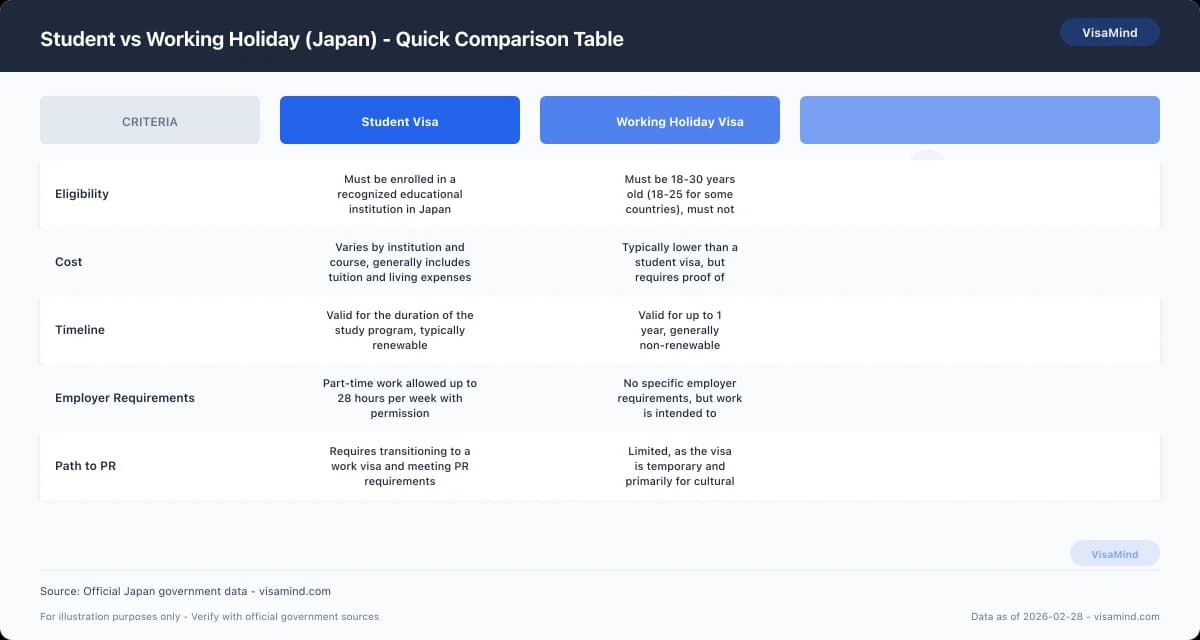
Understanding the differences between a Student Visa and a Working Holiday Visa is crucial for making the right choice. Below is a side-by-side comparison of key dimensions for these visas:
| Dimension | Student Visa | Working Holiday Visa |
|---|---|---|
| Eligibility | Open to those enrolled in a Japanese educational institution. | Typically for young people aged 18-30 from partner countries. |
| Cost | Varies by country; additional costs for tuition and living expenses apply. | Minimal visa application fee; must have funds for maintenance and a return ticket. |
| Timeline | Valid for the duration of the study program, usually 1-2 years, extendable. | Generally valid for up to 1 year, non-extendable. |
| Employer Requirements | Part-time work (up to 28 hours per week) allowed with permission. | Employment allowed, but must not be primary purpose; some job types prohibited. |
| Path to PR | Can lead to Permanent Residence after graduation, work, and fulfilling criteria. | Less direct path; mainly suitable for short-term cultural exchange. |
Eligibility
The Student Visa is aimed at individuals who have secured admission in a recognized Japanese educational institution. In contrast, the Working Holiday Visa caters to young people from specific partner countries (such as Australia, Canada, and Korea) who wish to experience Japan while supporting themselves through incidental employment. It's important to note that Working Holiday applicants must not have dependents or children accompanying them.
Cost Considerations
While the Student Visa may involve significant costs due to tuition and living expenses, the Working Holiday Visa requires applicants to demonstrate financial readiness by possessing either a return travel ticket or sufficient funds to purchase one, alongside proof of maintenance funds. This difference in cost structure can significantly impact your budget planning.
Timeline and Work Opportunities
The Student Visa typically aligns with the length of your study program, which can range from one to two years and is often extendable. During this period, students are allowed to work part-time, up to 28 hours per week, with proper permission. On the other hand, the Working Holiday Visa is generally valid for up to one year and promotes cultural exchange as its primary purpose. While it permits employment, certain job types, such as work in bars or nightclubs, are prohibited.
Important: Working Holiday participants must notify the Ministry of Justice within 14 days of finding a place to settle down to avoid potential penalties.
Path to Permanent Residence
For those considering long-term residency, the Student Visa provides a more structured pathway to Permanent Residence in Japan. Graduates can transition to work visas and eventually apply for permanent residency, provided they meet the necessary criteria. The Working Holiday Visa, however, is less suited for those aiming for permanent settlement, as it is primarily intended for temporary stay and cultural exchange.
For more detailed guidance on the Working Holiday Visa, refer to our Working Holiday Guide. If you're considering studying in Japan, explore the Student Visa for a deeper understanding of educational opportunities.
When to Pick the First Option
#"I was eager to experience Japan but wanted the freedom to explore while working part-time to support my travels. I wasn't sure if the Working Holiday Visa was right for me, as I didn't have a concrete work plan."
- Concern: "I worried about how I'd manage financially without a full-time job lined up before arriving in Japan."
- Preparation: I researched the requirements of the Working Holiday Visa and confirmed I met the age and nationality criteria. I gathered documents showing my financial stability, including bank statements that demonstrated I had reasonable funds to support myself initially. I also booked a return flight to satisfy the visa requirements.
- Outcome: After applying through the Japanese Embassy, I received my visa and traveled to Japan. The visa's flexibility allowed me to engage in various part-time jobs, such as teaching English and assisting at local guesthouses. This not only funded my travels but also enriched my cultural experience. The freedom to work in different settings made the Working Holiday Visa the perfect choice for my adventure.
Scenario 2: Gaining Work Experience and Enhancing Skills
"I wanted to improve my skills and gain international work experience, but I was torn between committing to full-time studies and having the freedom to work in Japan."
- Concern: "I needed a visa that allowed me to balance work and leisure while also considering my future career."
- Preparation: I compared the Student Visa and Working Holiday Visa. The Working Holiday Visa appealed to me because it allowed for incidental employment. I ensured I had a valid passport, a return ticket, and the necessary funds, as required by the visa guidelines.
- Outcome: With the Working Holiday Visa, I worked in a variety of fields, which enriched my resume. The exposure to Japan's work culture and language significantly improved my skills and confidence. The experience was invaluable for my career, and I returned home with a clearer understanding of my professional goals.
Scenario 3: Seeking Cultural Immersion and Personal Growth
"I was drawn to Japan's rich culture and wanted to immerse myself fully while maintaining some financial independence."
- Concern: "I wasn't sure how to finance an extended stay without a scholarship or full-time job."
- Preparation: I chose the Working Holiday Visa after confirming it allowed for cultural immersion and part-time work. I prepared by brushing up on the Japanese language and understanding the local job market to increase my employability.
- Outcome: The Working Holiday Visa offered a balance of work and travel. I lived in different parts of Japan, working in cafes and volunteering at cultural festivals. This allowed me to connect with locals and experience Japan beyond the tourist route. The personal growth and friendships I gained were invaluable, making this visa an ideal choice for my goals.
Tip: If cultural exchange and varied work experiences are your primary goals, the Working Holiday Visa offers the flexibility you need. For more information, refer to the Working Holiday Guide.
Choose Option B If...
#Important: Before deciding on a visa type, consider your primary goals and constraints in Japan, such as the ability to work, study, or explore the culture.
Exploring Japan and Gaining Work Experience
I was eager to explore Japan while also gaining some work experience, but I was concerned about whether I could sustain myself financially. The Working Holiday Visa seemed like an ideal option because it allows incidental employment to supplement travel funds while primarily being a holiday. I prepared by ensuring I met all the eligibility criteria, like having a valid passport and enough funds for my initial stay. After applying through the Japanese Embassy in my country, I received my visa approval. This allowed me to travel throughout Japan and work in part-time jobs, which helped me not only cover my expenses but also immerse myself in the local culture.
Balancing Travel with Cultural Exchange
I was worried about how to experience Japanese culture authentically while traveling. I learned that the Working Holiday Programme is designed for cultural exchange, which aligned perfectly with my goals. I made sure to have a clear plan for my travels and understood the need to notify the Ministry of Justice within 14 days of finding a place to settle down. By the time I arrived in Japan, I had secured a few short-term jobs in cafes and guesthouses, which not only supported me financially but also enriched my cultural experience. This approach allowed me to explore Japan while engaging in meaningful exchanges with locals.
Navigating Financial Concerns with Flexibility
My concern was whether I could handle the financial aspect of living in Japan without a steady income. I discovered that although the Working Holiday Visa is primarily for holidays, it offers the flexibility to work, which can alleviate financial stress. Before applying, I ensured I had enough funds to meet the initial requirements and budgeted for my stay, considering occasional employment. This planning paid off, as I was able to find part-time work that fit around my travel schedule. The experience provided me with a balanced lifestyle, combining travel and work without the pressure of a full-time commitment.
Key Differences Explained
#The Working Holiday Visa has distinct age criteria and eligibility requirements compared to the Student Visa. For a Working Holiday Visa, applicants must typically be between 18 and 30 years old. However, for nationals of countries like Australia, Canada, South Korea, and Ireland, the upper age limit is 25, unless extended to 30 by a bilateral agreement. In contrast, the Student Visa has no specific age limit, making it accessible to a broader age range of applicants.
Eligibility Requirements:
-
Working Holiday Visa:
- Age: 18-30 (some exceptions for specific countries)
- Must possess a valid passport and a return travel ticket or sufficient funds to purchase one
- Reasonable funds for maintenance during the stay
- Health: Must be in good health
- Must not have dependents accompanying
- First-time applicants only (with some exceptions)
-
Student Visa:
- No age limit
- Enrollment in a recognized educational institution in Japan
- Proof of financial means to support oneself during the study period
- Health: Must meet health requirements set by the educational institution
Purpose and Restrictions
The core purpose of each visa type also highlights their differences. The Working Holiday Visa is primarily designed for cultural exchange and tourism, with incidental employment allowed to supplement travel funds. On the other hand, the Student Visa focuses on education, allowing the holder to study in Japan full-time.
Important: While Working Holiday Visa holders can work to support their travels, engaging in certain types of employment, such as working at bars or nightclubs, is prohibited. Student Visa holders, meanwhile, need to obtain permission for part-time work, which is limited to 28 hours per week during the school term.
Application Process and Duration
The application processes for these visas differ, reflecting their unique purposes and requirements. A Working Holiday Visa application is lodged at the Japanese Embassy or Consulate-General in the applicant's home country, and it involves demonstrating the intent to travel and engage in cultural exchanges. The visa duration typically lasts for up to one year.
For the Student Visa, the process is more focused on educational arrangements. Applicants must first secure admission to a recognized institution in Japan. The Student Visa is usually granted for the duration of the study program and may require extensions based on the course length.
Comparison Table:
| Factor | Working Holiday Visa | Student Visa |
|---|---|---|
| Primary Purpose | Cultural exchange and tourism | Full-time study |
| Age Requirement | 18-30 (exceptions apply) | No specific age limit |
| Work Permission | Incidental employment allowed (restrictions apply) | Part-time work allowed (28-hour limit) |
| Duration | Up to 1 year | Duration of the study program |
For more detailed steps on applying, visit our How To Apply guide. Additionally, understanding the financial requirements is crucial; refer to our Financial Requirements guide for more information.
What People Get Wrong
#-
Age Limit Flexibility: A common misconception is that the age limit for the Working Holiday Visa is universally set at 30. However, for nationals from Australia, Canada, South Korea, and Ireland, the age limit may be 25 unless an agreement extends it to 30. Always check the specific requirements for your nationality.
-
Duration of Stay: Many assume that both the Student Visa and Working Holiday Visa allow indefinite stays. The Working Holiday Visa typically permits a stay of up to one year, while the Student Visa duration depends on the length of the academic program. For more details, see the Student Visa page.
Employment and Activity Restrictions
-
Employment Restrictions: A significant error involves misunderstanding the employment possibilities under each visa. The Working Holiday Visa allows for incidental employment to support travel, but working at prohibited establishments like bars or nightclubs is not allowed. The Student Visa, meanwhile, requires permission for any work outside of campus activities, and this is subject to hour limitations. More on this can be found under the Working Holiday guidelines.
-
Purpose of Stay: The Working Holiday Visa is primarily for a cultural exchange and not intended for long-term employment or study. Conversely, a Student Visa is intended for those attending educational institutions. Misrepresenting your purpose can lead to issues with the Immigration Services Agency of Japan.
Financial Requirements Misjudgments
- Proof of Funds: Both visas require proof of financial stability, but the criteria differ. For the Working Holiday Visa, you must show sufficient funds for maintenance and a return travel ticket, whereas the Student Visa might require additional financial proof related to tuition and living expenses. Refer to the Financial Requirements for specifics.
Important: Failing to notify the Ministry of Justice within 14 days after finding a place to settle can lead to compliance issues. Always adhere to this requirement to avoid complications during your stay in Japan.
Can You Switch Later?
#Switching from a Working Holiday Visa to a Student Visa or vice versa in Japan is possible, but it involves specific procedures and requirements. Understanding these can help you navigate the process efficiently.
Switching from Working Holiday to Student Visa
If you wish to transition from a Working Holiday Visa to a Student Visa, you'll need to apply for a change of status of residence through the Immigration Services Agency of Japan. Here's what you need to consider:
-
Eligibility Requirements:
- Acceptance by a Japanese educational institution.
- Proof of financial capability to support your studies and living expenses.
- A valid passport and residence card.
-
Application Process:
- Receive a Certificate of Eligibility (COE) from your educational institution.
- Submit a Change of Status of Residence application at the local immigration office.
- Provide necessary documentation, including the COE and proof of financial means.
Important: The processing time for a change of status can vary, so it's advisable to apply well before your current visa expires.
Switching from Student Visa to Working Holiday Visa
Transitioning from a Student Visa to a Working Holiday Visa is generally less common, given the specific nature of the Working Holiday Programmes. However, if eligible, you can apply through the Japanese Embassy or Consulate-General in your home country.
-
Eligibility Considerations:
- You must meet the age requirements (18-30) and have not previously been issued a Working Holiday Visa.
- Sufficient funds and a return ticket are necessary.
-
Application Steps:
- Obtain necessary documents, including proof of funds and health status.
- Lodge your application at the relevant Japanese diplomatic mission.
- Await approval and issuance of the visa.
Key Points to Remember
- Both transitions require careful planning and adherence to application guidelines.
- Each visa type serves different purposes: the Working Holiday Visa is for cultural exchange and incidental employment, while the Student Visa is focused on academic pursuits.
- Changing your visa status does not automatically extend your stay; ensure your new visa covers your intended duration in Japan.
For further details on eligibility and application processes, consider consulting the Visa Extension Guide or the Documents Checklist to ensure all necessary paperwork is prepared.
Who Chose What and Why
#"I was unsure whether to apply for a Student Visa or a Working Holiday Visa for my year abroad in Japan. I wanted the chance to study the language intensively but also hoped to work part-time to support myself. My main concern was balancing academic commitments with work opportunities. After researching, I decided to go for the Working Holiday Visa since it offered more flexibility for short-term employment without being tied to a strict curriculum. I prepared by securing sufficient funds to cover my initial expenses and ensured my health was up to par, as required by the Immigration Services Agency of Japan. Once I arrived, I notified the Ministry of Justice within the 14-day timeframe of finding accommodation, avoiding potential pitfalls. This decision allowed me to immerse myself in cultural experiences that a structured academic schedule might not have permitted."
"I was torn between the two visa options because I wanted to experience Japan as a tourist while also gaining work experience. However, I was worried about whether the Working Holiday Visa would provide enough structure for my professional development goals. In the end, I applied for the Student Visa since it allowed me to enroll in a program that combined language learning with cultural studies, and I could still work part-time to some extent. This path gave me a clearer framework to follow and helped me develop a routine, which was reassuring. I lodged my visa application through the Japanese Embassy in my country, ensuring all my documents were in order. As a result, I was able to focus on both my studies and interning at a local company, gaining valuable insights into Japanese business practices."
Important: If you're uncertain about which visa to apply for, consider what balance of work, travel, and study best suits your goals. Each visa has unique advantages that can shape your experience in Japan.
FAQs
Are there financial requirements for Student vs Working Holiday (Japan) visas?
Can I work on a Student Visa vs Working Holiday Visa (Japan)?
What are common pitfalls when applying for a Working Holiday Visa in Japan?
Is it possible to combine studies and work on a Working Holiday Visa in Japan?
What are the health requirements for Student vs Working Holiday (Japan) visas?
How do I notify the Ministry of Justice if I settle down in Japan on a Working Holiday Visa?
What should I do if I have been issued a Japanese working holiday visa in the past?
Sources
Last reviewed: March 1, 2026
VisaMind provides informational guidance only and is not a government agency. This is not legal advice. Requirements can change and eligibility depends on your specific facts. If your case is complex or high-stakes, consult a licensed immigration attorney.
Next steps
Requirements vary by nationality, purpose, timeline, and case details. Use Find My Visa to get a personalized checklist for Japan with official sources and deadlines.
Find my visa